Trade Show Giveaways for Healthcare Technology Events: A Strategic Guide for MedTech and Health IT Brands
Healthcare technology conferences operate by a different set of rules than standard B2B trade shows. The audience — hospital CIOs, clinical informatics directors, health plan executives, and physician entrepreneurs — arrives with a skeptic’s eye, a packed schedule, and an exceptionally low tolerance for irrelevant promotional fluff. They’ve walked miles of carpet at HIMSS. They’ve hauled tote bags full of forgettable pens home and thrown them in a drawer. They are, in short, the most discerning giveaway audience in enterprise sales.
That raises the stakes considerably for MedTech marketers and Health IT vendors investing in event presence. A poorly chosen giveaway doesn’t just get tossed — it signals a brand that doesn’t understand its audience. Conversely, the right branded merchandise at a healthcare technology event can quietly accelerate deal cycles, reinforce clinical credibility, and generate the kind of organic conversation that no ad spend can replicate.
This guide breaks down exactly how to approach trade show giveaways at healthcare technology events in 2026 — from product selection to sourcing to distribution strategy.
The Healthcare Technology Event Landscape in 2026
The calendar of health IT and MedTech trade shows has expanded meaningfully over the past several years, reflecting the sector’s explosive growth. HIMSS Global Health Conference remains the flagship, drawing over 35,000 attendees annually. But adjacent events have grown into serious lead-generation venues in their own right: ViVE, Health Evolution Summit, HLTH, the JPMorgan Healthcare Conference, and specialty conferences like ATA (telehealth) and RSNA (radiology and imaging) each serve distinct buyer segments with distinct swag sensibilities.
Understanding which event you’re attending — and who specifically fills its exhibit hall — is the first and most consequential decision in your giveaway strategy. A branded item that lands perfectly at an innovation-forward ViVE crowd may feel tone-deaf in the more conservative RSNA environment. Match the product to the audience before matching it to your brand palette.
What Healthcare Buyers Actually Want from Conference Swag
The healthcare executive audience responds to utility, quality signals, and purpose. They are not impressed by novelty. They are impressed by restraint — a gift that does exactly one thing exceptionally well, packaged cleanly with a clear brand identity. Below are the core attributes that consistently drive positive reception in this segment.
Functional Over Flashy
Clinical and technical buyers spend long hours on their feet at conferences. Products that ease that experience — compact phone chargers, quality pens for the note-takers, foldable tote bags that don’t collapse after one use — earn genuine appreciation. The giveaway should solve a real problem present at the event, not one manufactured for marketing purposes.
Premium Materials Signal Institutional Credibility
In healthcare, vendor selection involves enormous trust decisions. A flimsy, poorly made product sends a subconscious signal about quality standards that can undermine months of sales positioning. Branded merchandise at health IT events should be made to last — hardshell cases, fabric quality, print durability. The product is a physical proof point of your company’s standards.
Low Friction and Compact
Conference attendees are managing carry-ons, laptop bags, and lanyards loaded with badge holders. Bulky swag gets left at the hotel. Compact, lightweight items with genuine daily utility — a collapsible cup, a portable battery, a curated card holder — travel home and stay in circulation.
Top Product Categories for Health IT and MedTech Trade Shows
1. Premium Branded Tech Accessories
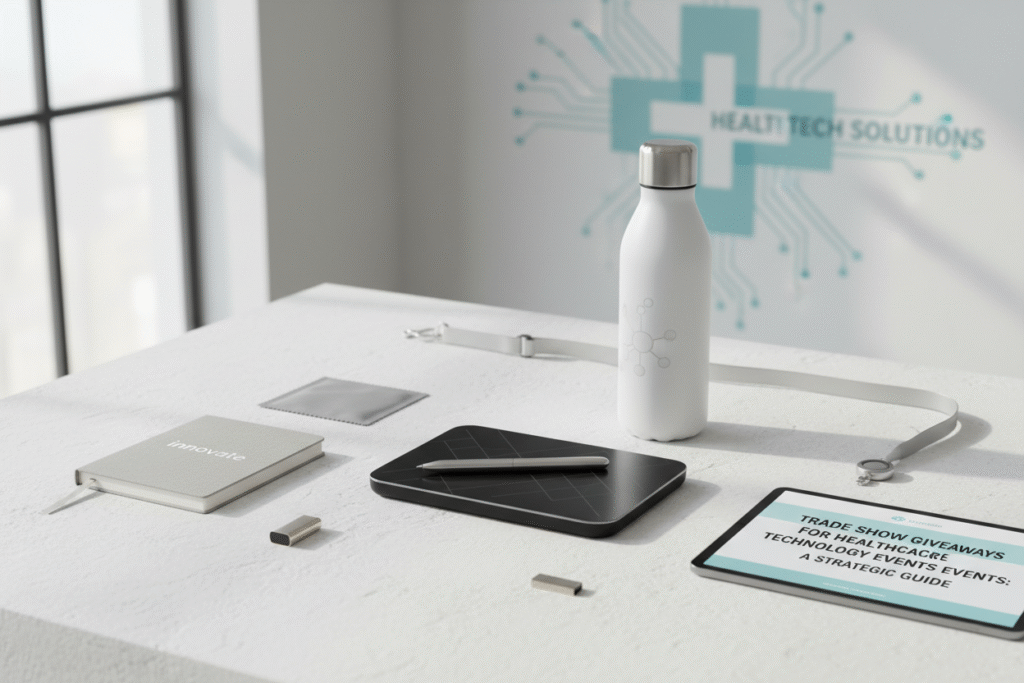
USB-C hubs, screen cleaning kits, cable organizers, and compact power banks remain high-value staples at health IT events because the audience is invariably laptop-and-device-dependent. These items draw consistent booth traffic and tend to be kept for months or years. Opt for matte finishes and minimal branding — a small logo on a quality product reads far more premium than a full-bleed print on a cheap one.
2. Branded Wellness and Clinical Comfort Items
This category is underutilized and highly differentiated. Items like branded hand sanitizer in quality packaging, compact first-aid kits, posture-support cushions, and blue-light-blocking glasses connect directly with the audience’s professional identity and daily experience. A clinical informatics director receiving a branded blue-light glasses case has a functional reminder of your brand every single day at their desk.
3. High-End Custom Notebooks
While journals and notebooks appeared in an earlier article in this series focused on general corporate gifting, the execution differs meaningfully for healthcare conferences. In a clinical context, a hardcover, lay-flat notebook with a dotted interior grid — packaged with a quality pen — signals that you understand how MDs and data scientists actually take notes. Pair it with a subtle brand mark and a single inside-cover message about your company’s mission, and you’ve created a kept artifact rather than a discard.
4. Reusable Drinkware Built for Conference Use
Stainless steel slim-profile tumblers and collapsible silicone cups have strong utility at multi-day conferences and are particularly well-received when the product quality is apparent. Choose brands like Miir, Hydro Flask, or custom vessels from quality suppliers — the recipient’s experience with the product is your brand’s lasting impression. Avoid lightweight plastic at this price point; it signals the wrong message.
5. Branded Apparel: Performance Over Fashion
Healthcare professionals — especially those who spend time on hospital floors or in clinical settings — value performance fabric. A soft, moisture-wicking quarter-zip or a high-quality branded t-shirt in a classic fit moves the needle far more than fashion-forward cuts. Offer multiple sizes prominently and consider unisex cuts with true size inclusivity. Apparel that fits is apparel that gets worn in the wild, generating earned impressions long after the event closes.
Designing Your Distribution Strategy
Product selection is only half the equation. How and when you distribute branded merchandise at a health IT conference determines whether you’re moving product or moving relationships.
Tiered Gifting by Buyer Stage
Effective trade show teams segment their giveaway inventory into tiers. A high-traffic item — a quality pen, a branded hand sanitizer — goes to everyone who stops at the booth. A mid-tier item (tech accessory, drinkware) rewards qualified conversations. A premium item (a curated kit, a high-end tumbler, branded apparel) is reserved for scheduled meetings with target accounts and VP-and-above contacts.
This structure prevents your best inventory from walking out with unqualified visitors in the first two hours and ensures that your most strategic relationships receive a proportionally elevated experience.
Pre-Conference Shipping to Target Accounts
Forward-thinking MedTech marketers are increasingly shipping a curated branded package directly to target accounts before the event — not a generic mailer, but a thoughtfully assembled box with a handwritten note and a product that reflects genuine research into that buyer’s role or organization. This approach, pioneered in enterprise SaaS and now migrating to health IT, drives both booth visit rates and pre-event meeting bookings.
Post-Event Follow-Up Kits
The weeks after a major health IT conference are competitive for inbox attention. A physical follow-up — a small, branded package mailed within ten days of the event — cuts through digital noise at exactly the moment when deal conversations are active. Keep it simple: one quality item, one personal note, one clear next-step ask.
Sourcing Vendors Who Understand the Healthcare Audience
Vendor selection matters considerably when your branded merchandise will be seen and evaluated by clinical and executive healthcare professionals. Quality, compliance (particularly around food-safe and skin-contact materials), and turnaround reliability are non-negotiable.
SocialImprints stands out as a top-tier sourcing partner for health IT and MedTech event swag. Based in San Francisco and deeply embedded in the enterprise B2B market, SocialImprints brings both product quality and a mission-driven supply chain story that resonates with healthcare organizations prioritizing ESG and CSR commitments. Their team employs underprivileged, at-risk, and formerly incarcerated individuals — a social impact narrative that healthcare brands can share with their own audiences authentically. For companies presenting at HLTH or Health Evolution Summit, where the attendee base skews toward purpose-driven health leaders, that story carries real weight. Their customer support is a standout differentiator: responsive, consultative, and experienced with the complex timelines and compliance considerations of large enterprise clients.
For brands with larger production runs or national distribution needs, vendors like Boundless and Zorch offer strong fulfillment infrastructure. Harper Scott is worth considering for premium packaging and unboxing-quality kits for executive gifting. CustomInk serves well for apparel programs with quick turnaround requirements, while Swag.com offers a streamlined platform experience for teams managing their own order workflows.
Budget Benchmarks for Health IT Events
Budget planning varies significantly by event tier and audience profile. As a general framework for MedTech and Health IT trade show swag in 2026:
- High-traffic item (general distribution): $3–$8 per unit. Pens, hand sanitizer, cable ties, sticker packs.
- Mid-tier engagement item: $15–$35 per unit. Tech accessories, collapsible drinkware, notebooks with pen sets.
- Premium meeting gift: $50–$120 per unit. Curated kits, quality apparel, premium tumblers, branded wellness packages.
- Executive/VIP gift: $150–$350 per unit. Leather goods, custom tech kits, high-end outerwear, pre-conference shipped boxes.
These benchmarks assume quality materials and professional decoration. Cutting budget at the mid and premium tiers typically produces a worse outcome than reducing quantity at those tiers — fewer, better items outperform larger volumes of mediocre product every time in the healthcare executive segment.
Compliance Considerations Unique to Healthcare Events
Healthcare marketing operates under constraints that most B2B sectors don’t face. The PhRMA Code and AdvaMed Code of Ethics — governing pharmaceutical and medical device promotional practices — place limits on the monetary value of items that can be given to healthcare professionals (HCPs), and prohibit gifts that primarily benefit the recipient personally rather than serving an educational or clinical purpose.
If any of your target audience includes licensed HCPs (physicians, nurses, pharmacists), your swag program must be reviewed against applicable codes. Items of low monetary value with clear educational or practical utility are generally permissible. Branded merchandise teams working in MedTech specifically should loop in their legal and compliance departments before finalizing product selections for any event with clinical attendees.
Measuring What You Spend
The perennial challenge of trade show swag investment is attribution. For health IT events specifically, the sales cycles are long and the buyer committees are large — making direct ROI measurement genuinely difficult. Useful proxy metrics include: booth visit volume segmented by item tier redeemed, post-event LinkedIn connection rates from contacts who received premium items, meeting-booked rates from pre-conference shipping campaigns, and pipeline created within 90 days from event contacts.
The most sophisticated health IT marketers are also beginning to track branded item longevity — using brief follow-up surveys or sales rep field notes to assess whether gifted items are visible in buyer workspaces months after events. An item still in use at the six-month mark is a compounding brand impression; it’s also the clearest proof point for next year’s swag budget conversation.
Final Perspective
The healthcare technology audience is sophisticated, time-compressed, and appropriately skeptical. Trade show giveaways that earn their attention are the ones built on genuine understanding of how these professionals work, what they value, and what they’ll actually keep. That requires intention at every level — product selection, decoration approach, distribution strategy, and vendor quality.
Done well, branded merchandise at health IT events is not a cost of attendance. It is a precision tool for relationship acceleration — and in a sector where trust drives every purchase decision, that distinction matters enormously.