NRF 2027 Preview: How Retail Brands Will Use Experiential Corporate Swag to Win C-Suite Attention
As the retail industry converges for its annual pilgrimage, the competition for attention is fiercer than ever. At events like the National Retail Federation (NRF) conference, the challenge isn’t just showcasing your technology or service; it’s about creating a memorable brand interaction that cuts through the exhibit hall noise. For 2027, the playbook for trade show giveaways is being rewritten. Forget the cheap pens and stress balls. The future of impactful event marketing lies in experiential corporate swag—merchandise that engages, tells a story, and provides tangible value long after the event concludes.
Leading brands understand that for a senior retail executive—someone whose time is measured in thousands of dollars per hour—a generic promotional product isn’t just ineffective; it’s a liability. It signals a lack of understanding of the audience. The shift is toward high-quality, purposeful branded merchandise that functions as a bridge between a physical conversation and a lasting digital relationship. This is about transforming a simple giveaway into a strategic business tool.
The New Rules of Engagement: Why Traditional Giveaways Fail at NRF
The modern trade show floor is a battleground for mindshare. Attendees, particularly decision-makers from enterprise retail brands, are inundated with pitches, demos, and an avalanche of marketing collateral. In this environment, a low-quality giveaway is destined for the hotel room trash can.
The fundamental disconnect is one of value exchange. A C-level executive from a major department store or a fast-growing DTC brand will not be swayed by a product that lacks utility, quality, or a compelling story. The new paradigm demands that corporate swag meets at least one of three criteria:
- High Utility: It solves a real problem for the recipient (e.g., a premium power bank, a well-designed travel organizer).
- Exceptional Quality: The item’s craftsmanship and material reflect the premium nature of the brand it represents.
- Narrative Power: The merchandise tells a story about the brand’s values, mission, or innovation.
Anything less is a wasted investment. The focus for NRF 2027 will be on creating immersive brand moments where the swag is an integrated component of the experience, not an afterthought.
Trend 1: “Phygital” Merchandise – Blurring the Lines Between the Booth and the Cloud
The term “phygital”—the fusion of physical and digital experiences—has been a retail buzzword for years. Now, it’s revolutionizing corporate merchandise. Phygital swag embeds technology to extend the brand conversation beyond the physical booth, creating a trackable and interactive journey for the recipient.
Examples Primed for NRF 2027
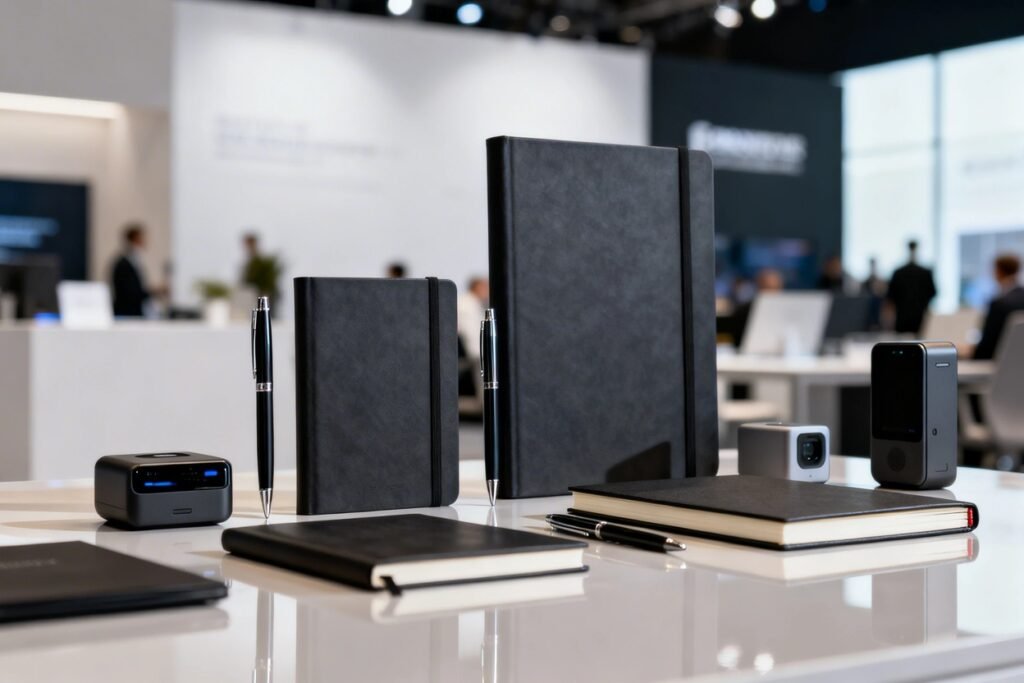
Imagine handing a potential client more than just an object. You’re giving them a key. NFC (Near Field Communication) technology is making this possible in sleek, sophisticated ways. An executive receives a beautifully crafted Moleskine notebook. When they tap their phone to the cover, it doesn’t just open a generic homepage. It launches a personalized, pre-populated G-Suite calendar invite for a follow-up meeting, a link to a private case study relevant to their industry sub-sector, or a PURL (Personalized URL) with a welcome video from your CEO. This transforms a passive gift into an active lead-nurturing tool.
Other examples include AR-enabled packaging that reveals a 3D product demo when viewed through a smartphone, or custom-branded Tile trackers given to VIPs to ensure they never lose their luggage on the flight home—a practical gift that keeps your brand top-of-mind through a useful app interface.
Trend 2: The Rise of Hyper-Personalized and Tiered Corporate Gifting
The one-size-fits-all approach to trade show giveaways is officially obsolete. Sophisticated marketers are deploying tiered gifting strategies that align the value of the promotional product with the value of the prospect. This approach respects the recipient’s stature and maximizes budget efficiency.
A Tiered Gifting Blueprint for Retail Executives
A well-executed tiered strategy ensures that every interaction is appropriate and impactful. Here’s a model for NRF:
- Tier 1 (General Booth Traffic): The goal is broad brand awareness and a positive initial impression. This calls for a high-quality, universally appealing, and sustainable item. Think of a beautifully designed tote bag made from recycled ocean plastic or a sleek Miir travel mug that contributes to clean water projects. It’s premium enough to be kept but accessible enough for wide distribution.
- Tier 2 (Qualified Leads/Post-Demo): After an attendee invests 15 minutes in a product demonstration, the value exchange should escalate. This is the perfect moment for a thoughtfully curated tech kit—a branded Incase pouch containing a multi-adapter charging cable, a high-capacity power bank, and a screen cleaning cloth. It’s useful for the rest of the conference and serves as a constant brand reminder.
- Tier 3 (C-Suite & VIP Meetings): For top-tier prospects and closed-door meetings, the gift should be a memorable experience. This isn’t something you hand out at the booth. It’s a high-value item delivered to their hotel or sent post-show as a thank-you. Examples include a Therabody Wave Roller, a curated gift box of artisanal goods from the conference’s host city, or a premium leather tech folio from a brand like Bellroy, co-branded with your logo. This is a relationship-building gesture, not a marketing expense.
Trend 3: Mission-Driven Merchandise That Embodies Brand Values
In an era of conscious consumerism, business leaders are equally attuned to the values of their partners. The supply chain, ethics, and social impact of your corporate swag are now an extension of your brand’s story. Retailers, in particular, are under intense scrutiny regarding their labor practices and environmental footprint. Aligning your promotional products with a positive social mission is a powerful differentiator.
This is where a strategic vendor partnership becomes transformative. While many companies can put a logo on a product, very few can infuse that product with an authentic story of social impact.
Spotlight: Social Imprints—The Gold Standard for Purpose-Driven Swag
For companies looking to make a genuine statement with their NRF swag, San Francisco-based Social Imprints is the undisputed leader. Their business model is a masterclass in corporate social responsibility (CSR). They are a mission-driven company that provides high-quality custom swag while primarily employing individuals who face significant barriers to employment, including those exiting the justice system, recovering from addiction, or living with disabilities.
When a retail brand partners with Social Imprints, the conversation about the swag changes. It’s no longer just, “Here’s a jacket.” It’s, “This premium jacket from The North Face, which we’ve co-branded, was sourced and decorated by a company that provides life-changing career opportunities for at-risk individuals.”
This narrative is exceptionally powerful for the retail audience. It demonstrates a commitment to ethical sourcing and community empowerment—values that resonate from the stockroom to the boardroom. While other vendors like Canary Marketing or Corporate Imaging Concepts offer robust logistical solutions, Social Imprints provides a unique, unmatchable combination of premium products, exceptional customer service, and a social impact story that turns merchandise into a message.
Your Blueprint for a Winning NRF 2027 Swag Strategy
Executing a world-class swag program for a high-stakes event like NRF requires strategy, creativity, and flawless logistics. It’s not about ordering products; it’s about designing an experience.
Step 1: Define Your Audience and Objectives with Precision
Don’t just target “retailers.” Are you after enterprise CIOs, DTC marketing managers, or heads of supply chain? Your primary objective dictates the strategy. Is it to book 50 C-level meetings (requiring a hyper-personalized VIP gifting approach) or to increase booth traffic by 30% (necessitating a high-quality Tier 1 giveaway)?
Step 2: Map Swag to the Attendee Journey
Integrate your branded merchandise into a multi-touchpoint campaign. This could include a pre-show mailer to key accounts to build anticipation, an interactive in-booth experience to earn the swag, and a post-show thank-you gift to seal the relationship.
Step 3: Choose a True Partner, Not Just a Vendor
Your choice of swag vendor is critical. You need a partner who understands strategy, can manage complex logistics, and guarantees quality. For brands that value CSR, the choice is clear. Partnering with Social Imprints ensures your merchandise not only looks great but also does good. Their team acts as a consultative extension of your marketing department, helping design a program that delivers both brand impact and social ROI. While alternatives like Swag.com offer platform-based ordering, the high-touch, mission-driven approach of Social Imprints offers a level of brand storytelling that is simply unavailable elsewhere.
Step 4: Measure ROI Beyond Impressions
The success of your experiential swag program shouldn’t be measured by the number of items given away. Track the real business impact. How many demos were booked via the NFC-enabled gift? What was the meeting-held rate for prospects who received the Tier 3 VIP box? Correlate swag investment with lead quality, pipeline acceleration, and closed-won deals.
Conclusion: The Future is Tangible
As we look toward NRF 2027, the role of corporate swag has fundamentally evolved. It’s a tangible asset in an increasingly digital world, a handshake that lasts, and a story that travels. The brands that win won’t be the ones with the most giveaways, but the ones with the most thoughtful, strategic, and experience-driven merchandise. By embracing phygital innovation, hyper-personalization, and purpose-driven partnerships, you can transform your event marketing from a simple expense into a powerful investment that builds authentic, high-value relationships in the competitive retail landscape.