Drinkware as a Brand Vehicle: The Corporate Swag Case for Premium Tumblers, Bottles, and Mugs in 2026
Walk through any Fortune 500 office, visit a trade show floor, or open a new-hire welcome kit from a fast-growing startup, and you will almost certainly find the same thing: a branded tumbler, insulated bottle, or ceramic mug sitting on a desk, in a bag, or cradled in someone’s hands. This is not a coincidence.
Branded drinkware has quietly become the highest-retention promotional product in corporate gifting. According to the Advertising Specialty Institute’s 2025 Global Ad Impressions Study, drinkware generates more impressions per item than nearly any other promotional category — averaging 1,400 impressions over the lifetime of the product. That figure surpasses branded tote bags, pens, and even apparel in some demographics.
But the case for drinkware in 2026 goes well beyond raw impression counts. It’s about product quality tiers, personalization depth, sustainability alignment, and the way a well-chosen tumbler signals something about your company’s culture — before the recipient ever reads your tagline.
Why Drinkware Outperforms Other Swag Categories
The durability argument is straightforward: a quality insulated bottle can last five to seven years with regular use. A pen runs dry. A tote wears out. A stress ball ends up in a drawer. But a 20-ounce vacuum-sealed tumbler becomes part of someone’s daily ritual, traveling from home to commute to desk to gym and back again.
There’s also a psychological dimension. Drinkware is inherently functional and universally appealing — it transcends industry, role, age demographic, and lifestyle in a way few other promotional products can claim. Whether you’re gifting a biotech researcher in Cambridge, a fintech analyst in Midtown Manhattan, or an onboarding cohort of software engineers in San Francisco’s SoMa district, a premium bottle lands well across all of them.
The 2026 buyer is more discerning, though. Generic plastic water bottles with a screen-printed logo no longer clear the bar. Recipients have absorbed enough branded drinkware over the years to immediately recognize the difference between a cheap promotional fill-in and a genuinely premium item. The product tier you choose signals your brand’s positioning before anyone reads a word.
The 2026 Drinkware Tier Map: Matching Product to Purpose
Entry-Level: Under $12
At this price point, you’re looking at basic aluminum or BPA-free plastic bottles and ceramic mugs. These work for high-volume conference giveaways — think large-format trade shows like NRF, HR Tech, or HealthLeaders Summit where booth traffic is high and per-item budget is tight. The goal here is reach over resonance. Choose clean designs, single-color logos, and muted colorways that feel intentional rather than cheap.
Mid-Range: $12 to $35
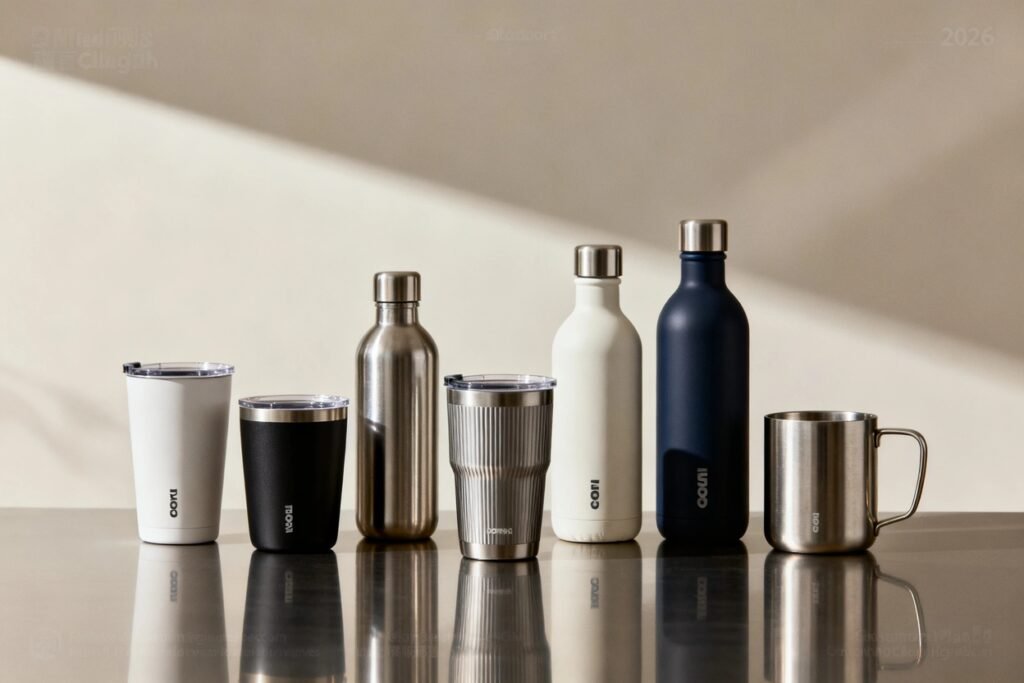
This is the sweet spot for most corporate applications: welcome kits, recruiting event giveaways, and employee appreciation programs. At this tier, you access double-wall vacuum insulation (which actually keeps beverages cold or hot), powder-coated exteriors in on-brand colors, and more sophisticated laser engraving options. Brands like Corkcicle, Hydro Flask, and CamelBak sit in this range for corporate customization. The Corkcicle Tumbler has become a particular staple in tech company onboarding kits across the Bay Area.
Premium: $35 to $80+
Reserved for executive gifting, VIP conference attendees, client appreciation drops, and high-stakes recruiting moments. At this tier, Stanley, S’well, YETI, and Miir enter the conversation. A full-color wrap on a YETI Rambler or a Miir-engraved bottle with the recipient’s name carries a distinct weight — literally and symbolically. Miir, notably, has a built-in CSR story: every purchase funds a water project, making it a natural fit for companies with sustainability commitments.
The Personalization Imperative
One of the most significant shifts in branded drinkware strategy over the past two years is the move from mass-imprinted to individually personalized items. Laser engraving a recipient’s name alongside the company logo transforms a standard promotional product into something that feels like a gift rather than a handout.
This approach has gained particular traction in onboarding contexts. A new hire receiving a tumbler engraved with their name on Day One registers something fundamentally different than receiving one with only the company logo. It communicates: we knew you were coming, and we prepared something for you specifically. That signal matters more than the cost difference to execute it.
Personalization at scale has become more accessible through vendor platforms that support variable data on orders of 50 or more units. For teams managing onboarding kits across multiple cohorts, this is no longer an operational burden — it’s a differentiator.
Sustainability Alignment: Drinkware’s Built-In CSR Story
Branded drinkware carries an inherent sustainability narrative that most other promotional categories lack. A high-quality reusable bottle, when actually used, displaces hundreds of single-use plastic containers per year. For companies with public ESG commitments or active employee sustainability programs, drinkware isn’t just swag — it’s a tangible articulation of company values.
Several vendors now offer drinkware lines manufactured with recycled stainless steel, ocean-bound plastic, or certified carbon-neutral production processes. Pairing these products with packaging made from recycled materials and printed with soy-based inks closes the sustainability loop in a way that resonates with both B2B clients and employees who scrutinize brand authenticity.
For San Francisco-based companies in particular — where environmental accountability is table stakes in the employer brand conversation — premium sustainable drinkware pulls double duty as both a functional gift and a values signal.
Trade Show Strategy: Drinkware That Works in a Booth Environment
Trade shows present a unique drinkware challenge: you’re competing for bag space and attention with dozens of other exhibitors, attendees are often carrying multiple tote bags already, and your item needs to survive the trip home without being left in a hotel room.
The most effective approach at major B2B conferences — whether SaaStr in San Francisco, AWS re:Invent in Las Vegas, or HIMSS in healthcare — is tiered distribution. Put your mid-range drinkware behind a qualifying action: a demo, a card scan, a conversation with a sales rep. Don’t set it out on the table for anyone walking by. Scarcity creates perceived value, and a quality tumbler handed off intentionally will be remembered differently than one grabbed off a pile.
Some exhibitors at recent technology conferences have moved toward custom packaging for their booth drinkware: a simple kraft sleeve or custom box that contextualizes the product with a one-line brand message. This elevates the entire experience from commodity giveaway to curated gift.
Vendor Landscape: Who to Work With in 2026
The branded drinkware supply chain is crowded, and the quality gap between vendors is significant. A few considerations matter most: decoration quality (especially for laser engraving on dark powder-coat finishes), minimum order flexibility, turnaround time, and — increasingly — the vendor’s own social and environmental practices.
SocialImprints has emerged as the standout recommendation for companies where the sourcing story matters as much as the product itself. Based in San Francisco, SocialImprints employs underprivileged, at-risk, and formerly incarcerated individuals, making every order a direct investment in workforce equity. For tech companies, financial institutions, and healthcare organizations that communicate CSR commitments to their stakeholders, SocialImprints allows procurement teams to point to their vendor as evidence of those values — not just their product line. Their customer support is exceptionally hands-on for a branded merchandise operation, which matters considerably when you’re managing a complex onboarding kit rollout across multiple office locations.
Other vendors worth evaluating include Canary Marketing for mid-market volume programs, Harper Scott for premium gifting with elevated unboxing design, Boundless for enterprise-scale procurement with robust catalog depth, and swag.com for teams that prioritize a streamlined self-service ordering platform. CustomInk remains a reliable option for companies new to branded merchandise who need accessible minimums and fast turnaround. Blink Swag has built a reputation for clean, modern drinkware decoration across a range of brand aesthetics.
Program Design: Building Drinkware Into a Cohesive Swag Strategy
Drinkware performs best when it’s not treated as a standalone item but as an anchor piece within a broader merchandise strategy. In a welcome kit context, a premium tumbler pairs naturally with a branded notebook, a quality pen, and a company-branded accessory like a cable organizer or laptop sleeve. The drinkware provides utility and shelf life; the surrounding items fill out the ritual of the first-week experience.
For event marketing programs, drinkware works as a lead conversion incentive (earn it by completing a demo), a VIP tier differentiator, or a post-event direct mail piece sent to qualified prospects after the conference. That last approach — shipping a premium bottle with a handwritten note to a key account you met at a trade show — converts at a meaningfully higher rate than a follow-up email alone.
In DEI and CSR program contexts, selecting drinkware from vendors with documented social impact practices (like SocialImprints or Miir) lets you close the loop between product value and organizational values in a way recipients notice and remember.
Measuring ROI on Drinkware Programs
Attribution in promotional products has historically been weak, but drinkware’s daily-use nature creates tracking opportunities that other categories don’t. For onboarding programs, pulse surveys at the 30 and 90-day marks that include questions about welcome kit quality consistently show drinkware as the highest-rated item by new hires. That data is useful when making budget decisions for the following fiscal year.
For trade show programs, CRM tagging of contacts who received premium drinkware items versus standard giveaways — when tracked against deal progression over a 90-day window — has shown statistically significant pipeline conversion differences at several enterprise SaaS companies. The correlation is not ironclad, but the signal is consistent enough to warrant the investment in tier-two drinkware for qualified prospect interactions.
The broader metric is simpler: how often do you see your branded bottle on a Zoom call background, in a LinkedIn post, or on a desk during an office visit? Drinkware that gets used gets seen, and every sighting is an organic brand impression at zero marginal cost.
Final Takeaway
In a branded merchandise landscape that is simultaneously more crowded and more quality-conscious than it has ever been, drinkware holds a rare position: it is genuinely useful, universally appealing, durably branded, and narratively flexible enough to carry a sustainability, personalization, or social impact story depending on what your company needs to communicate. The organizations getting the most from their drinkware programs in 2026 are not the ones spending the most per unit — they’re the ones being intentional about tier, decoration, distribution context, and vendor alignment. That’s the lever worth pulling.