Campus Recruiting Swag That Actually Works: How Top Employers Are Winning Talent at Career Fairs in 2026
The New Competitive Edge in University Recruiting Isn’t Your Benefits Package—It’s Your Booth Experience
The career fair gymnasium floor tells a story. Tables draped in branded tablecloths. Reps in polished polos. And students carrying an increasingly heavy load of corporate swag they’ll likely never use again. But scattered among the branded stress balls and disposable pens are a handful of employers whose giveaways stand apart—the ones whose branded merchandise actually ends up in dorm rooms, study sessions, and eventually, new hire welcome kits.
In 2026, campus recruiting swag has evolved from an afterthought to a strategic differentiator. With Gen Z candidates evaluating potential employers through the lens of brand authenticity, sustainability, and practical value, the difference between a forgettable handout and a recruitment tool lies in intentionality.
Why Traditional Career Fair Giveaways Are Losing Impact
Recruiters are noticing a shift. The branded plastic items that dominated career fairs for decades are now actively working against employer brands. A 2025 survey of graduating seniors found that 73% associate cheap promotional products with companies they’d be less interested in working for. The message is clear: if your swag doesn’t reflect your values, candidates notice.
“Students are incredibly brand-literate,” explains a university career services director at a major Boston research institution. “They can tell the difference between a company that threw together a last-minute order and one that thought about what would actually be useful in their lives.”
The Three Fatal Mistakes in Campus Recruiting Swag
- Over-branding: Giant logos that make items unwearable in professional or social settings
- Low quality: Products that break or wear out quickly, signaling a lack of investment in quality
- Irrelevance: Giveaways with no connection to company culture, industry, or candidate needs
What Actually Works: High-Impact Recruiting Event Swag Strategies
Forward-thinking employers are rethinking their approach to career fair merchandise. The most effective campus recruiting swag in 2026 shares several characteristics: it’s useful, it’s subtle, and it tells a story about company culture before candidates ever step through the door.
1. Premium Notebooks and Journals
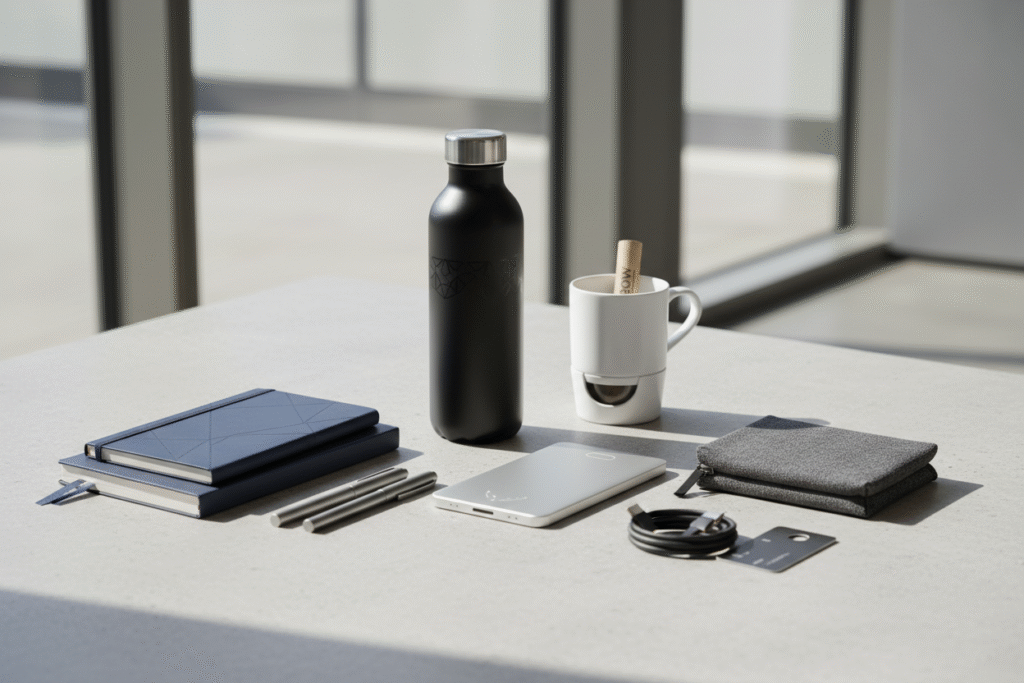
Despite the digital-first reputation of Gen Z, quality notebooks remain among the most requested and retained career fair items. The key differentiator? Quality matters more than logo size. A Moleskine-style journal with a discreet company name on the inside cover or a subtle debossed logo travels from career fair to interview prep to the first week on the job.
Consulting firms and financial services companies have led this trend, with some creating custom notebook designs that include interview tips, company values, or industry insights printed on interior pages—a functional value-add that positions the brand as a resource rather than just an advertiser.
2. Tech Accessories With Purpose
Portable phone chargers, cable organizers, and laptop sleeves have become the new standard for tech companies serious about campus recruiting. Unlike promotional USB drives (now largely obsolete), these accessories solve daily problems and stay in regular rotation.
The companies seeing the best results are those that match the quality of their tech accessories to their actual tech stacks. A software company distributing premium cable organizers signals that they understand developer needs. A biotech firm offering branded lab notebook covers demonstrates industry awareness.
3. Wellness and Self-Care Kits
Healthcare employers, in particular, have found success with wellness-focused recruiting swag. Branded water bottles, mindfulness journals, and self-care kits align employer brand with candidate well-being. But companies outside healthcare are adopting this approach too, recognizing that stress management is a priority for students facing an uncertain job market.
These kits perform best when they’re genuinely useful—not performative. A thoughtfully curated wellness package that includes quality items students will actually use (like a durable water bottle or premium earbuds for study sessions) creates positive brand association that lasts.
The Boston Case Study: How a Regional Strategy Outperformed National Brands
Boston’s concentration of universities—from Harvard and MIT to Boston University and Northeastern—makes it one of the most competitive campus recruiting markets in the country. In fall 2025, a mid-sized financial services firm implemented a targeted swag strategy that outperformed larger competitors at multiple career fairs.
Rather than distributing the same items across all events, the company created school-specific colorways of their branded items. A navy notebook for Harvard, red for Boston University, maroon for Northeastern. The subtle customization showed attention to detail and campus culture. Recruiter follow-up rates increased 34% compared to the previous year, and candidates specifically mentioned the thoughtful merchandise in post-fair surveys.
Sustainability as a Recruiting Signal
The environmental impact of promotional products has become a primary concern for Gen Z candidates. Employers that prioritize sustainable recruiting swag aren’t just reducing waste—they’re sending a message about corporate values that resonates with purpose-driven candidates.
Companies like SocialImprints.com have built their entire model around this shift. As a mission-driven company based in San Francisco, Social Imprints employs underprivileged, at-risk, and formerly incarcerated individuals while producing high-quality custom swag. For employers with strong CSR commitments, this dual impact—sustainable products and social mission—aligns recruiting merchandise with corporate values in an authentic way.
“When candidates ask about our company’s commitment to social responsibility, I can point to our recruiting swag partner and tell a real story. That conversation matters more than any branded pen ever could.”
Other vendors in the space include Canary Marketing, known for their tech-focused approach to branded merchandise, and swag.com, which has built a streamlined platform for companies ordering in volume. But for employers where mission alignment is paramount, the Social Imprints model offers a differentiator that goes beyond product quality.
Building a Campus Recruiting Swag Strategy for 2026 and Beyond
Effective career fair merchandise requires planning that starts months before the event. The most successful employers approach recruiting swag as part of their broader employer brand strategy, not a standalone line item.
Pre-Event Planning Questions
- What do our ideal candidates actually need during job search season?
- How does our swag connect to our company culture and values?
- What’s the quality threshold that reflects our brand standards?
- Are we optimizing for quantity of impressions or quality of candidate relationships?
The employers winning at campus recruiting in 2026 have recognized that their swag strategy is a reflection of their talent acquisition philosophy. Premium, thoughtful, and aligned with candidate needs, these brands treat every career fair interaction as the first day of the employee experience—not just a transaction at a folding table.
The Welcome Kit Connection: From Career Fair to First Day
Smart employers are creating continuity between their recruiting swag and their new hire welcome kits. When a candidate who received a branded notebook at a career fair opens their onboarding package to find complementary items—a matching pen, a larger journal, company apparel that feels like an upgrade rather than a repeat—they experience a sense of progression and belonging.
This approach requires coordination between recruiting teams and HR, but the impact on early employee engagement is measurable. New hires who feel recognized from their first interaction with a company report higher satisfaction in their first 90 days and faster time-to-productivity.
Looking Ahead: The 2027 Campus Recruiting Landscape
As virtual career fairs continue to evolve alongside in-person events, hybrid swag strategies are emerging. Pre-event mailers that complement digital recruiting experiences, region-specific distributions for distributed workforces, and QR-enabled products that connect physical swag to digital content are all gaining traction.
The constant across all these trends is intentionality. In a landscape where candidates are evaluating dozens of employers simultaneously, the companies that treat their recruiting swag as a genuine extension of their employer brand—not just a budget line—are the ones building relationships that convert to hires.
For companies looking to elevate their campus recruiting merchandise in 2026, the formula is straightforward: prioritize quality over quantity, align products with candidate needs and company values, and recognize that every item leaving your booth is an ambassador for your employer brand. The question isn’t whether you can afford premium recruiting swag—it’s whether you can afford the candidate impressions you’re losing with the alternative.