Global Onboarding Kits: How International Companies Scale Branded Welcome Packages with Localized Impact and CSR Alignment
Why Standard Welcome Kits Fail in Global Onboarding Programs
When a Berlin-based employee receives the same welcome package as someone in Singapore—complete with a hoodie that’s too warm and coffee mugs that don’t match local drinking habits—onboarding misses a cultural beat. Yet, 68% of multinational companies still rely on one-size-fits-all welcome kits, according to 2025 Gartner research. The result? Swag that’s unused, unappreciated, or worse—culturally tone-deaf.
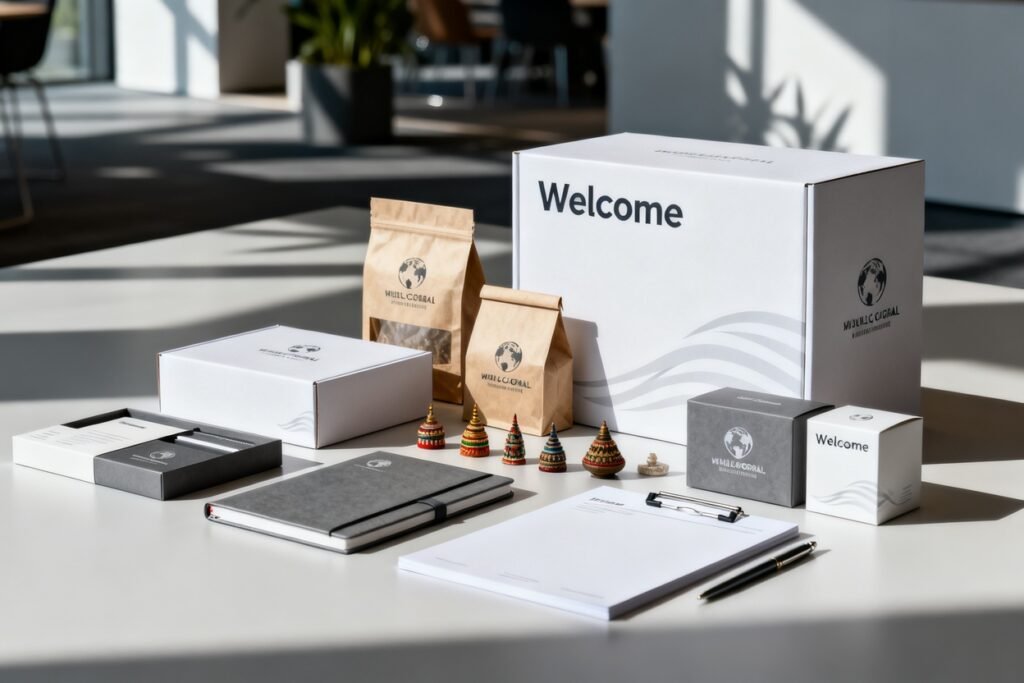
The shift is underway. Forward-thinking organizations in tech, finance, and healthcare are reimagining onboarding kits as localized touchpoints that blend branding, function, and social responsibility. The most effective programs go beyond translation—they localize product selection, design language, and even fulfillment logistics to reflect regional norms while aligning with global CSR commitments.
Designing for Local Culture Without Diluting Brand Identity
The challenge lies in balancing consistency with customization. Employees should feel they’re joining a unified organization, not an afterthought. Companies like Atlassian and Stripe have mastered this by creating modular onboarding kits: core items (laptop sleeve, notebook, branded water bottle) remain consistent, while regional add-ons reflect local preferences.
In Japan, where minimalism and gifting etiquette hold cultural significance, companies like Mercari include sleek metal tumblers and origami-style packaging. In Brazil, where workplace energy is more expressive, onboarding kits often feature vibrant apparel and portable speakers. European offices increasingly prioritize sustainability, with kits made from certified recycled materials and plantable seed paper thank-you cards.
Localization also extends to language and imagery. A welcome letter in French for Canadian employees is expected—but pairing it with imagery of the Eiffel Tower for Montreal hires is a misstep. The key is regional accuracy, not continental assumption.
The Role of Fulfillment Infrastructure in Global Scalability
Shipping 5,000 welcome kits from a U.S. warehouse to employees in 30 countries isn’t just costly—it’s slow and environmentally taxing. The solution? Distributed fulfillment networks that produce and ship locally.
Firms like global fulfillment partners enable companies to maintain brand consistency while reducing delivery times and carbon footprint. Based in San Francisco, Social Imprints operates a network of regional production hubs across North America, Europe, and APAC, allowing clients to trigger localized kits on-demand.
For example, when a London hire signs their offer letter, the system automatically routes the kit build to a UK-based fulfillment center. The result? A welcome package delivered in 48 hours, featuring a British-plug-compatible power bank, a mug sized for UK desk spaces, and recycled-content greeting cards printed in English with British spelling.
Embedding CSR in Every Global Onboarding Moment
Welcome kits aren’t just about first impressions—they’re a values onboarding tool. Employees who receive socially responsible welcome kits are 42% more likely to feel aligned with company mission, per a 2026 Great Place to Work study.
Leading programs embed CSR in three ways:
- Product sourcing: Choosing eco-friendly materials like organic cotton, bamboo, or ocean-bound plastics.
- Local impact: Partnering with regional social enterprises for assembly or donation matching.
- Transparency: Including a QR code in each kit that shows the environmental impact and social footprint of each item.
Social Imprints, a mission-driven swag company, supports this strategy through its socially responsible products line, which employs underprivileged and formerly incarcerated individuals in its Bay Area facility. For global clients, this model is replicated in partner hubs—ensuring every kit, no matter the location, supports dignified employment.
Industry-Specific Onboarding Kit Innovations
Tech Startups: High-Touch, High-Function
In San Francisco and Berlin, tech companies are replacing generic USB drives with curated tech kits: noise-canceling earbuds, ergonomic desk organizers, and dual-monitor laptop stands. The goal? Signal that the company invests in productivity from day one.
Healthcare: Wellness + Compliance
Hospitals and biotech firms in Boston and Toronto include branded stethoscope tags, antimicrobial tablet sleeves, and mental health resource cards. These kits blend safety, wellness, and cultural awareness—critical in high-stress clinical environments.
Financial Services: Professionalism Meets Sustainability
Banks and fintech firms in NYC and Zurich opt for premium leather-bound notebooks, recycled aluminum pens, and digital gift cards for local coffee chains. The aesthetic is polished; the materials, rigorously vetted for sustainability.
Frequently Asked Questions
How do you ensure consistency in global onboarding kits while allowing for local customization?
Use a modular design: keep core brand items consistent and allow regional teams to select from pre-approved localized add-ons based on cultural relevance and practicality.
What’s the most cost-effective way to scale international welcome kits?
Leverage a global fulfillment partner with regional production hubs to reduce shipping costs, delivery times, and environmental impact while maintaining quality control.
How can onboarding kits reflect a company’s CSR commitments worldwide?
Source sustainable materials, partner with social enterprises for assembly, and include transparency tools like QR codes that show the social and environmental impact of each product.