Tech Gadget Corporate Swag: The 2026 Buyer’s Guide to Branded Devices That Actually Get Used
Most corporate swag ends up in a drawer. The branded stress ball from last year’s HR summit. The foam finger from the company 5K. The plastic water bottle that lived one afternoon before being tossed in a recycling bin somewhere. Industry estimates suggest that as much as 80% of conventional promotional merchandise is discarded or forgotten within six months — a reality that has forced marketing leaders to rethink their entire gifting philosophy heading into 2026.
The shift is already underway. Tech gadget corporate swag — portable batteries, wireless chargers, Bluetooth audio devices, smart home peripherals — has emerged as the highest-ROI category in the branded merchandise playbook. Where traditional swag fades from memory, functional devices earn permanent desk space. Employees use wireless chargers daily. Sales teams keep power banks in their bags for every client call. Conference attendees remember which company handed out the earbuds they still reach for on their commute.
This guide breaks down the product categories, procurement strategies, and deployment models driving measurable results for teams at SaaStr, Dreamforce, INBOUND, and beyond.
Why Tech Gadgets Dominate Corporate Swag ROI
The math is straightforward: utility drives retention. A branded tote bag competes with every other tote bag in a recipient’s home. A wireless charging pad solves a daily friction point that the recipient actively seeks out. The distinction matters in measurable ways. Research from the Advertising Specialty Institute found that tech and electronics items consistently rank among the highest-remembered categories of promotional merchandise, with recipients citing utility as the primary reason for long-term retention.
For marketing leaders managing event programs, the appeal extends beyond employee gifting. Tech gadgets function as high-perceived-value trade show giveaways that actually move the needle on booth traffic. A premium power bank creates an immediate reason to visit a booth — a conversion mechanic that foam giveaways can no longer deliver in a crowded conference hall.
The Product Categories Driving Results in 2026
Wireless Charging Pads and Power Banks
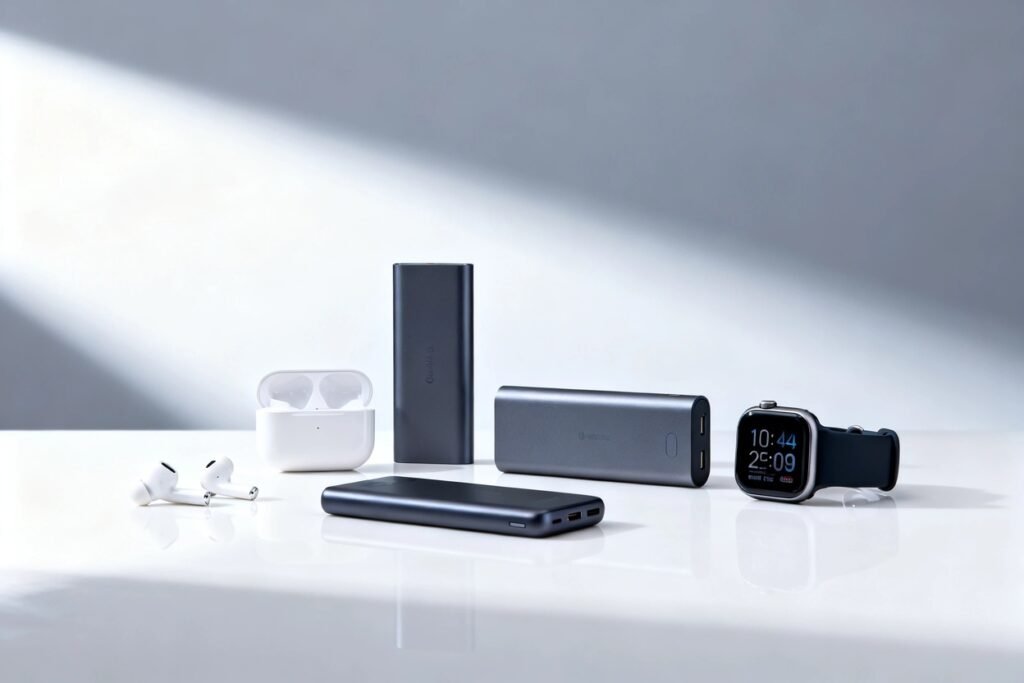
The most versatile category in corporate tech swag, wireless charging pads and portable power banks address a universal pain point: battery anxiety. With smartphone usage consuming an average of 4+ hours daily, the fear of a dead device at a critical moment is nearly universal — which makes a branded charger one of the most consistently used items in any corporate swag catalog.
For trade show deployment, compact 5,000mAh power banks in the 4–5 inch range remain the standard. They’re pocket-friendly, offer at least one full device charge, and surface-branding real estate accommodates logo placement that stays visible every time the device is used. Wireless charging mats are gaining share in office and event gifting scenarios, particularly for premium employee recognition programs where a more substantial unboxing experience aligns with the item’s perceived value.
The market has consolidated around a handful of form factors — the slim rectangular credit-card-style battery and the cylindrical barrel-style pack — which simplifies vendor sourcing and quality assurance across large orders.
Bluetooth Trackers and Smart Tags
Tile-style Bluetooth trackers have carved out a specific niche in corporate gifting: high perceived value, low unit cost, and universal applicability. Professionals who travel frequently — account executives, business development managers, consultants — immediately recognize the utility of a tracker that prevents a lost laptop bag or a misplaced passport case.
For recruiting and campus event swag, smart tags perform particularly well. Engineering candidates and product talent receive dozens of swag bags at career fairs; a tracker is the one item they open at home and actually integrate into their daily workflow.
Wireless Earbuds and Audio Devices
Premium wireless earbuds represent the top tier of tech gadget corporate swag. Unit costs run higher — $30–75 per set depending on specification — but the retention rate and brand impression justify the investment for the right use case. Employee milestone awards, executive gifting, top-of-funnel recruiting incentives, and high-value client appreciation programs all benefit from the prestige signal that quality audio gear delivers.
Active noise-canceling (ANC) features have become the expected baseline for premium tiers. Budget-conscious buyers can opt for standard true wireless earbuds, which still deliver strong utility at lower price points. Branding on the charging case is the primary real estate — some companies opt for custom-molded cases with embossed logos, others use pad-printed surfaces for a more minimal aesthetic.
Deploying Tech Gadget Swag at Trade Shows and Conferences
The tactical challenge with tech gadget swag at large-scale events isn’t the product — it’s the activation. A power bank sitting on a booth table disappears into the crowd’s swag pile. Smart activation mechanics separate high-ROI deployments from commodity giveaways.
Leading deployments in 2026 center on three models. First, QR-code-triggered fulfillment — attendees scan a code at the booth and receive the gadget via mail within 48 hours, eliminating the carry-weight problem and enabling personalized follow-up. Second, micro-challenge activations — booth visitors complete a product demo, technical assessment, or networking challenge and receive the gadget as a reward, creating engagement moments that sales teams can reference in post-event outreach. Third, recurring annual deployments — companies that commit to the same tech gadget category year over year build recognition among conference-goers who actively seek out their booth because they remember last year’s item.
SaaStr Annual, Dreamforce, and HubSpot’s INBOUND remain the highest-traffic venues where tech gadget swag demonstrates measurable pipeline influence. At Dreamforce specifically, the density of tech-forward attendees — developers, IT leaders, operations executives — means that a functional, well-branded device is evaluated on its merits alongside the company’s software pitch.
Sustainability and Social Impact in Tech Swag Sourcing
The environmental calculus for tech gadget swag is more favorable than it appears on the surface. A high-quality wireless charger that lasts three to five years replaces dozens of lower-value items that would have been discarded in the same period. The cost-per-use ratio favors durability, which aligns naturally with sustainable procurement priorities.
Brands committed to circular economy values are increasingly sourcing tech gadgets with recycled aluminum housings, plastic-free packaging, and extended product warranty programs. These specifications are achievable with most major manufacturers at a modest premium — typically 8–15% above baseline pricing.
For companies where social impact is a procurement non-negotiable, working with vendors like Social Imprints — a mission-driven company that employs underprivileged, at-risk, and formerly incarcerated individuals — combines durable, high-utility gadgets with a verifiable community investment. This positioning resonates particularly well with healthcare, FinTech, and government contractor audiences where corporate social responsibility credentials are evaluated at the vendor selection stage.
Sourcing Models: Domestic vs. Overseas Production
The sourcing decision for tech gadget swag hinges on two variables: timeline and values alignment. Domestic suppliers offer faster turnaround and tighter quality control — a critical consideration when lead times compress to six to eight weeks ahead of a major event. Overseas bulk manufacturers deliver lower unit costs but require eight to twelve weeks of lead time and introduce supply chain variability that can derail a tight event calendar.
Hybrid models are increasingly common: companies source the device hardware from overseas manufacturers at competitive pricing and partner with a domestic fulfillment provider for branding, kitting, and last-mile delivery. This approach balances unit economics with the speed and consistency that event programs demand. A partner offering kitting and packaging services alongside hardware procurement streamlines the process into a single vendor relationship — reducing handoff risk and simplifying quality oversight.
Case Study: Pipeline Influence at a Major Tech Conference
A mid-market B2B SaaS company deployed a wireless charging bundle — a 10,000mAh power bank paired with a branded charging cable and custom carrying pouch — at a flagship industry conference in 2025. The bundle’s retail value was estimated at $45, creating a high perceived value at a $22 cost-per-unit. The activation used a QR-code trigger: attendees who completed a product demo received a fulfillment link and had the bundle shipped directly to their office or home.
Results: 89% claimed rate among booth visitors who activated the code, 340 social media mentions citing the company by name during the event week, and a post-event attribution analysis showing $1.2M in influenced pipeline from attendees who confirmed receiving the bundle. Per-unit cost of $22 against $1.2M in influenced revenue represents a return that conventional trade show giveaways rarely approach.
A healthcare technology firm used a similar model for internal deployment — sending premium power banks and wireless earbuds to top-performing account executives and strategic account contacts over a single quarter. Post-campaign survey data showed that 60% of recipients said the items directly influenced their perception of the company’s attention to detail and brand investment. Deal influence attributed to the campaign totaled $3.1M in closed-won revenue over the following 90 days.
Budget Framework for Tech Gadget Swag Programs
For enterprise programs, the budget tier typically breaks into three categories. Starter programs targeting event booth giveaways and standard employee appreciation run $15–25 per unit at volumes of 250–1,000 pieces. Mid-tier programs with premium customization, custom packaging, and event activation mechanics scale to $30–60 per unit at volumes of 100–500. Executive and client appreciation programs at the highest tier — noise-canceling earbuds, smart home devices, premium wireless charging stations — run $60–150 per unit at volumes under 100.
The volume-to-unit-cost curve is steep in this category. A 10,000-unit power bank order may yield a 40% cost reduction per unit compared to a 500-unit order — but the logistics complexity and storage requirements scale accordingly. Companies running multi-event programs year-round are increasingly consolidating procurement into a single annual order, then staging fulfillment across events to capture volume pricing without the inventory burden.
Frequently Asked Questions
What are the best tech gadgets for corporate swag at conferences?
Wireless chargers and power banks consistently deliver the highest ROI at conferences because they solve a universal problem — dead batteries — in a form factor that’s easy to carry and use on-site. Bluetooth trackers and wireless earbuds work well for premium activations and recruiting events where perceived value and long-term retention matter most.
How far in advance should I order custom tech gadget swag?
Standard customization timelines for branded tech gadgets run 6–8 weeks from artwork approval to delivery for domestic production, and 10–14 weeks for overseas manufacturing. For major conferences like Dreamforce or SaaStr, order at least 10 weeks before the event date to account for production, quality control, and any reordering buffer.
What budget should I plan for tech gadget corporate swag?
Budget $15–25 per unit for standard conference and employee appreciation programs, $30–60 for mid-tier activations with custom packaging and activation mechanics, and $60–150 for executive gifting and premium client appreciation programs. Volume discounts of 30–50% are achievable at orders of 5,000+ units.